Wednesday, March 27, 2013

Army cutworms

Don't let the above happen to your wheat or alfalfa field!! As mentioned in last week's publication of CropWatch, four or more cutworms per square foot in an established field (or two or more in a new or stressed stand of wheat or alfalfa) can significantly reduce yield potential. The center image was the approximate number of army cutworms found per square foot in the field on the right. The field on the right is supposed to be a field of winter wheat. Where's the wheat!? Well, some of the seed blew out due to the extremely dry weather that we have had for months now. However, as you can see in the image on the far left, the wheat that did emerge is not being grazed on by the kind of livestock that you could sell. This field is a little too late to be saved. On the other hand, in the spirit of "making lemonade out of lemons", you could make wine. And, yes, these caterpillars will turn into 'miller moths', so there is, I think, a high potential for a large miller moth population this year.

Thursday, March 14, 2013

Insect resistance in dry beans
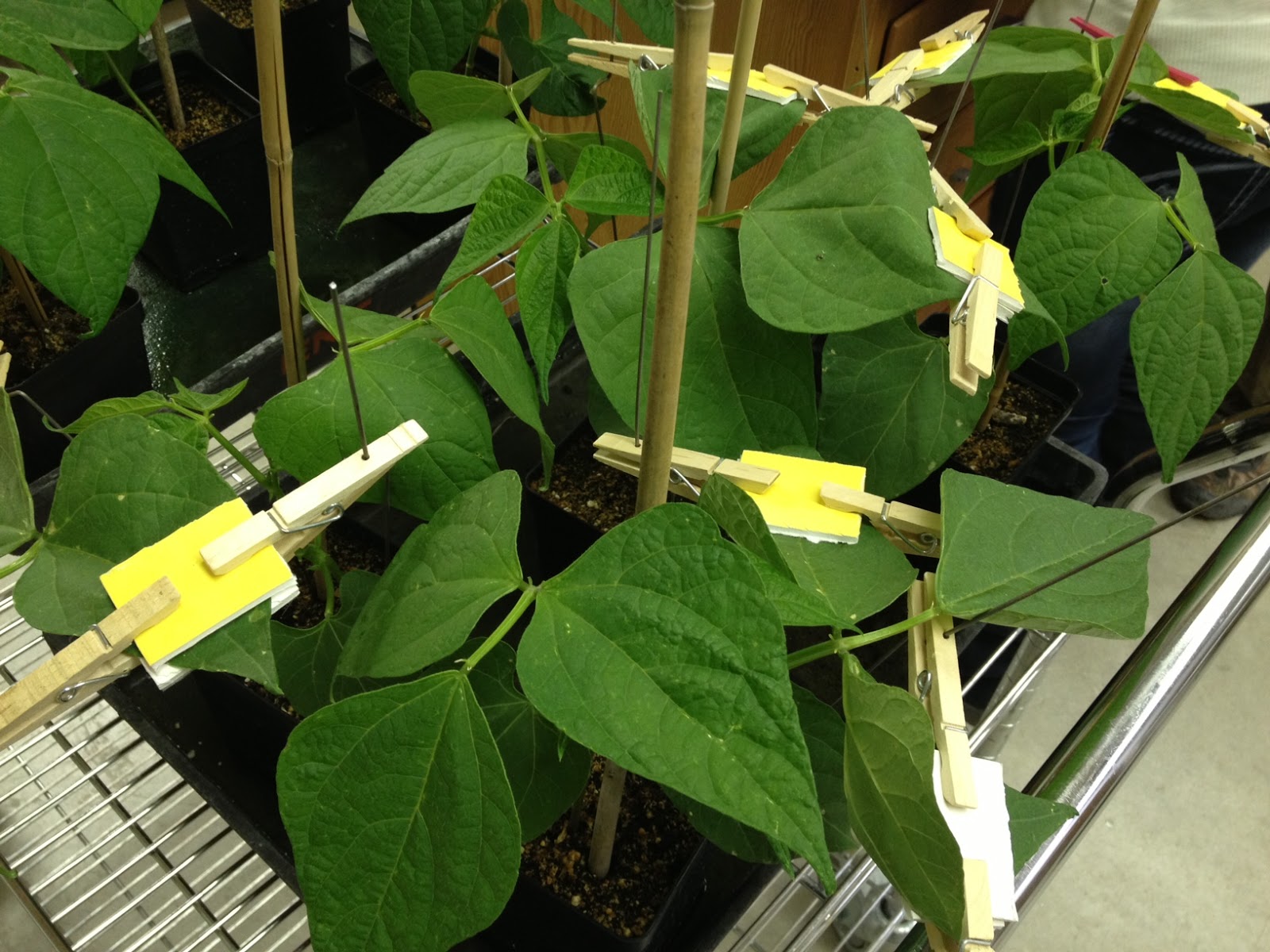
It has been a while since I've posted. We have been quite busy in the lab with a long list of projects as well as some laboratory renovation preparations. It has been a while since I've posted on our progress toward finding resistance to Mexican bean beetles in dry edible beans. We have made a lot of progress. We have tested beetle populations for two, presumably, divergent beetle populations and have found that certain varieties of pinto beans (and a couple other market classes) yield significantly lighter beetle larvae. The mass of an insect's larval stage over a measured period of time has been used in many bioassays as a measure for host suitability. Over a side-by-side comparison of treatments (different dry bean varieties in this case) we can measure the gain in larval mass over a set number of days and compare those weights across treatments. Lighter larvae are then assumed to be less fit and presumably (if the experiment is designed properly) there is some characteristic of the plant that caused the larvae from one variety to weigh less than another. As illustrated here, our bioassays to date have used a "detatched leaf method". This method allows us to test a large number of varieties at once. However, some plant defense compounds are known to be affected by different kinds of plant injury and some kinds of injury actually stimulate a delayed response that travels throughout the plant. Since we cut away the leaf material from the plant in our bioassays, we could be interfering with some important plant resistance mechanisms that may be expressed differently when you remove tissue from a plant. So the image on this page shows another kind of bioassay that we have just begun. In this bioassay we have designed small cages to contain the Mexican bean beetle larvae on leaves that are still attached to the plant. We are using the same varieties that we think represent the extremes of susceptibility and resistance to the beetles. We hope that this bioassay will agree with our cut-leaf bioassay, but we won't know for a few more days. Stay tuned for more....

Friday, July 27, 2012

In recognition of the 2012 Bradshaw Entomology Lab...


So, it has been another great summer in the lab with another great crew (pictured to the right is everyone but Sean and Kelli). Sure there is plenty of work left to do in order to finish out the season; however, about 1/3 of the lab will be left after most of them go back off to school next month. So, I took the opportunity to take a photo today. I got a bit carried away this year and designed t-shirts for the lab.

There is sort of a Nebraska story and tradition that explains the "entomology blackshirts" shirts that we are wearing. According to Wikipedia, "The Blackshirts are the first-string defensive unit players for the Nebraska Cornhuskers football team." The short of it is that Nebraska football coaches in the 1960s began giving out black shirts to their top defensive teams. It eventually became a tradition where players had to "earn" their black practice shirts and at some point the entire Nebraska football defensive line became popularly known (at least in Nebraska and to all Husker fans) as "Blackshirts". So I felt it apt to hand out my blackshirts about mid-season once the summer crew had earned them. You can see the shirt fronts in the photos. The symbol for the Husker Blackshirts is often a skull and crossbones. Therefore, obviously, the back of the shirts have a screen print of Acherontia lachesis (the death's head hawkmoth, of Silence of the Lambs fame). There are actually three species of Acherontia that are commonly known as death's head moths. However, Acherontia lachesis could be roughly translated from old Greek as "proportioner of pain" and I kind of like the ring of that. This may seem as a bit of an eccentric act; however, a well-rooted team needs a bit of mythology and I have got a rock-solid crew deserving of my gratitude. Go team!

Sunday, July 15, 2012

More sawfly damage...

As indicated in a previous post, 2012 has been a boom year for wheat stem sawfly damage. I decided to put together a short video. I have had a few phone calls to the office inquiring about lodged wheat and some word-of-mouth chatter that would indicate that some wheat producers do not recognize wheat stem sawfly damage. It has been a windy year for a windy part of the country, so apparently a number of producers, understandably, are blaming their lodged wheat on the wind. Some are blaming the lodged wheat on the variety and suggesting that the variety that they planted had poor straw strength (or poorer than expected). This is only part of the story. Because the wheat stem sawfly girdles wheat tillers near the base late in the growing season, it often takes a bit of wind to knock the wheat down. When the wheat finally does fall, it often does so in dramatic fashion. The video is a bit of a crude "Duke Dukem" style view of sawfly damage, but I think it gets the point across.

Friday, July 6, 2012

Inventive students

An undergraduate in my lab developing a device to carry cow dung samples. That's right dung samples. She is working on a project that explores the attraction of dung beetles to various "qualities" of cow dung. She needed a better way of transporting her bait into the field. I've been telling my students this summer that they have unofficial minors in arts & crafts.

Friday, June 22, 2012

Wheat harvest

Time to harvest wheat in the PREC entomology lab. Wheat harvest is perhaps three weeks early this year. It has been a warm year! Riley (undergrad student in the foreground) and Susan (lab tech with a face full of wheat in the background) are hauling in some stems that we will split to evaluate the presence of wheat stem sawflies.

Saturday, May 19, 2012

2012 looks to be a big year for Cephis cinctus

A female wheat stem sawfly resting on wheat awns. (5/15/12)

The wheat stem sawfly, Cephus cinctus, is having a boom year in 2012. This insect is a pest of wheat. The female sawflies (pictured above) deposit a single egg into a wheat stem (a single female sawfly will visit at least 10 wheat stems to deposit her eggs). The larvae that result will feed inside the hollow wheat stem until they are large enough to pupate. At that time the larva will move down the stem and make a pupal chamber near the wheat crown. However, before it develops into a pupa, the larvae will cut the wheat stem a few inches above the pupal chamber. This cutting activity (with the assistance of the wind) will cause the wheat tiller to fall, taking the wheat head and its grain with it to the ground. This year I have had numerous producers and crop scouts commenting on their presence. Locations that normally have infestations are reporting high numbers of sawflies and they are being found in locations where they have not been normally seen before. Unfortunately, there is little that can be done. Chemical control is not effective in their control. We currently do not have high-yielding winter wheat varieties with resistance against this insect. As I've briefly mentioned before, I am on the hunt to locate beneficial insects that might reduce their numbers. I currently have more than 30 wheat fields enrolled in a survey to determine the current distribution of the wheat stem sawfly and the parasitoid wasps that attack it. My lab is collecting as many production practices that we can from the producers that manage these fields. With any luck, I hope to find relationships between production practices and what roll they might play in mitigating sawfly numbers or in improving habitat quality for its natural enemies.