Some ground beetle are generalist predators and will feed on other ground beetles. It's thought that agricultural ground with higher residue (like sugar beet fields with minimum tillage following a maize crop from the previous year) provide greater habitat and shelter for more ground beetle species. That is, some of the smaller ground beetles that might otherwise be fed on by the larger predators have a place to hide. This, in turn, might free up time for those generalist predators to attack other insects (e.g., pest insects). At least, that could be one hypothesis. Others suggest that reducing tillage conserves habitat within the soil for the larvae of these ground beetles (they larvae are also soil dwelling and less mobile than adults) and thus increases their numbers within a field. The two ideas are probably not mutually exclusive.
Friday, September 13, 2013
Ground beetles are helpful beetles.
Over the past three years my doctoral student, Johan Pretorius, has been busy measuring the ecological services (i.e., benefits) provided by some of the insects commonly found roaming on the ground in sugar beet fields. We are working on sugar beet because the Western Sugar Cooperative has been very supportive of this work and it is a vital commodity for producers in western Nebraska. This work could (and hopefully will) be done in other crop settings and systems, but this is where we have started. Through our experiments and sampling, we have found that ground beetles (Carabidae) are the most prevalent group of arthropods within these western-Nebraska systems (sugar beets following maize). Other researchers have had similar observations with ground beetles being highly abundant in their agricultural systems as well. We have found about 40 species that reside in our sugar beets fields! The reason this is a very interesting and exciting find is that in recent years researchers have found that many ground beetle species provide a number of benefits to agricultural systems (if properly managed). All of these species have various micro-habitat, seasonality, and food preferences. Some species are strict seed feeders while others are voracious carnivores. This raises a couple questions: What are they doing in beet fields? How might their number be encouraged?
Some ground beetle are generalist predators and will feed on other ground beetles. It's thought that agricultural ground with higher residue (like sugar beet fields with minimum tillage following a maize crop from the previous year) provide greater habitat and shelter for more ground beetle species. That is, some of the smaller ground beetles that might otherwise be fed on by the larger predators have a place to hide. This, in turn, might free up time for those generalist predators to attack other insects (e.g., pest insects). At least, that could be one hypothesis. Others suggest that reducing tillage conserves habitat within the soil for the larvae of these ground beetles (they larvae are also soil dwelling and less mobile than adults) and thus increases their numbers within a field. The two ideas are probably not mutually exclusive.
Part of our studies have been focused on how tillage influences ground beetle habitat. However, we have also been very interested in the functional ecology of this group. Through our studies, it turns out that these beetles eat some of our pests insects common to sugar beet (e.g., the sugar beet root aphid) as well as some of our most tough-to-control weeds (e.g. kochia, foxtail, lambsquarters, and baryard grass). The video shows one of our bioassay choice tests. The beetles in the petri dishes are being given a choice between the seed of the four above-mentioned weed species. In this video you can see Harpalus eraticus (labeled as HE) and Amara carinata (labeled as AC). Some of the beetles are clearly more actively moving that others. We found Harpalus eraticus to be a voracious seed feeder; a single individual consumes as many as 20 Kocia seeds in a 12-hour time period! A single Kocia seed can produce a plant that will in turn produce tens of thousands of seed. So, the impact potential of this one species might be huge! With our growing problems with herbicide-tolerant weeds, our understanding of the role of ground beetles in agriculture and what we might do to encourage their numbers seems of growing importance.
Some ground beetle are generalist predators and will feed on other ground beetles. It's thought that agricultural ground with higher residue (like sugar beet fields with minimum tillage following a maize crop from the previous year) provide greater habitat and shelter for more ground beetle species. That is, some of the smaller ground beetles that might otherwise be fed on by the larger predators have a place to hide. This, in turn, might free up time for those generalist predators to attack other insects (e.g., pest insects). At least, that could be one hypothesis. Others suggest that reducing tillage conserves habitat within the soil for the larvae of these ground beetles (they larvae are also soil dwelling and less mobile than adults) and thus increases their numbers within a field. The two ideas are probably not mutually exclusive.

Wednesday, March 27, 2013
Army cutworms

Thursday, March 14, 2013
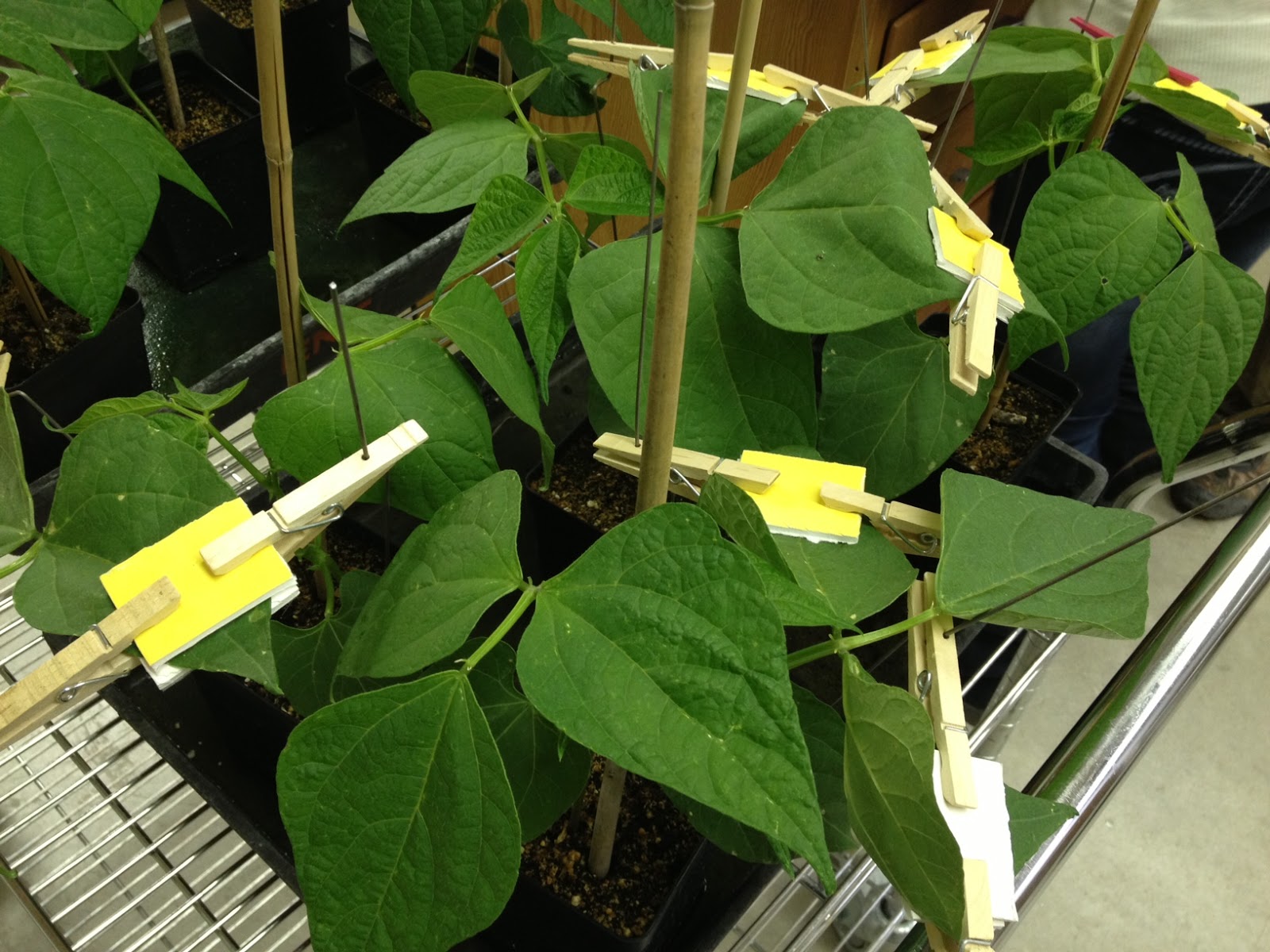
Insect resistance in dry beans
Friday, July 27, 2012
In recognition of the 2012 Bradshaw Entomology Lab...

 So, it has been another great summer in the lab with another great crew (pictured to the right is everyone but Sean and Kelli). Sure there is plenty of work left to do in order to finish out the season; however, about 1/3 of the lab will be left after most of them go back off to school next month. So, I took the opportunity to take a photo today. I got a bit carried away this year and designed t-shirts for the lab.
There is sort of a Nebraska story and tradition that explains the "entomology blackshirts" shirts that we are wearing. According to Wikipedia, "The Blackshirts are the first-string defensive unit players for the Nebraska Cornhuskers football team." The short of it is that Nebraska football coaches in the 1960s began giving out black shirts to their top defensive teams. It eventually became a tradition where players had to "earn" their black practice shirts and at some point the entire Nebraska football defensive line became popularly known (at least in Nebraska and to all Husker fans) as "Blackshirts". So I felt it apt to hand out my blackshirts about mid-season once the summer crew had earned them. You can see the shirt fronts in the photos. The symbol for the Husker Blackshirts is often a skull and crossbones. Therefore, obviously, the back of the shirts have a screen print of Acherontia lachesis (the death's head hawkmoth, of Silence of the Lambs fame). There are actually three species of Acherontia that are commonly known as death's head moths. However, Acherontia lachesis could be roughly translated from old Greek as "proportioner of pain" and I kind of like the ring of that. This may seem as a bit of an eccentric act; however, a well-rooted team needs a bit of mythology and I have got a rock-solid crew deserving of my gratitude. Go team!

Sunday, July 15, 2012
More sawfly damage...
As indicated in a previous post, 2012 has been a boom year for wheat stem sawfly damage. I decided to put together a short video. I have had a few phone calls to the office inquiring about lodged wheat and some word-of-mouth chatter that would indicate that some wheat producers do not recognize wheat stem sawfly damage. It has been a windy year for a windy part of the country, so apparently a number of producers, understandably, are blaming their lodged wheat on the wind. Some are blaming the lodged wheat on the variety and suggesting that the variety that they planted had poor straw strength (or poorer than expected). This is only part of the story. Because the wheat stem sawfly girdles wheat tillers near the base late in the growing season, it often takes a bit of wind to knock the wheat down. When the wheat finally does fall, it often does so in dramatic fashion. The video is a bit of a crude "Duke Dukem" style view of sawfly damage, but I think it gets the point across.
Friday, July 6, 2012
Inventive students
An undergraduate in my lab developing a device to carry cow dung samples. That's right dung samples. She is working on a project that explores the attraction of dung beetles to various "qualities" of cow dung. She needed a better way of transporting her bait into the field. I've been telling my students this summer that they have unofficial minors in arts & crafts. 
Friday, June 22, 2012
Wheat harvest
Time to harvest wheat in the PREC entomology lab. Wheat harvest is perhaps three weeks early this year. It has been a warm year! Riley (undergrad student in the foreground) and Susan (lab tech with a face full of wheat in the background) are hauling in some stems that we will split to evaluate the presence of wheat stem sawflies.
Saturday, May 19, 2012
2012 looks to be a big year for Cephis cinctus
 | ||
| A female wheat stem sawfly resting on wheat awns. (5/15/12) |
Sunday, April 22, 2012
Dung beetles
 |
| A pinned, adult specimen of Phanaeus vindex, the 'rainbow scarab'. It is one of the more colorful beetles that bury dung to protect and feed their offspring. |
My lab has added poo to our list of "study subjects". Cow poo in particular. My new postdoc, Sean Whipple, has some interesting ideas regarding the role of dung beetles to provide ecosystem services. He recently completed his dung-beetle focused doctorate program at UN-L. Continuing on this work, my lab intends to explore the roles that these diminutive creatures play in such things as restoring carbon and nitrogen back into rangelands and pastures in the Great Plains. Perhaps, more importantly, what can we do in managing our pastures and range to facilitate the activities of dung beetles. The previous work that has been published has indicated that these insects can have tremendous value even in reducing particular greenhouse gases that would otherwise emanate from our rangeland and pastures. As much as ~80% of greenhouse gas emissions have been found to be sequestered by these insects on rangeland. You may these numbers surprising; however, these insects can incorporate dung back into the sod very quickly. In fact, many dung beetle species prefer fresh cattle dung and so they (particularly the dung beetle species that bury their dung or 'brood' balls) move this fresh excrement into the soil very quickly as they compete for this resource.
Some dung beetles are rather striking (e.g., the above specimen of Phanaeus vindex) and we generally think of them as rolling balls of dung across the grasslands. (Many species such as P. vindex take their brood balls directly into the ground, without rolling them around.) However, there are many species (across a couple taxonomic families) of 'dung beetle', some of which would not necessarily strike you as a dung beetle and they can be quite tiny. Nevertheless, even the smallest dung beetles (see video of some small dung beetles in the subfamily Aphodiinae) work to break down feces as the adults and their offspring carve up the resource. This process can also facilitate the entry of fungi that can further break down the dung. There will be much more on this topic appearing here in the near future.
Wednesday, January 4, 2012
Wheat stem sawfly and its parasitoids
I will be discussing this in more detail at next weeks Crop Production Clinics in North Platte and Gering, but I needed to test out a new blog posting scheme. This was as good a reason as any. The image (from left to right) is Cephus cinctus, Bracon cephi and Bracon lissogaster (the parasitoids identifications are pending additional confirmation.


Saturday, October 8, 2011
Sun spider
 |
| A Solifugae (Class Arachnida, order Solifugae [=Solpugida]) from Nebraska. |
I have seen these before in collections and as 'pets' in terrariums, but I've never had someone bring one in for an identification. Maybe you have already noticed that this animal doesn't look like your every-day spider. It isn't. They do belong to the same class as spiders, Arachnida, but they are in a different order, the Solifugae. There are a couple characteristics that make these critters stand out. The chelicerae are fashioned into a set of vertical pincer-like appendages that hang in from of a small set of eyes. Also, count the legs ... Spiders have 8 (4 pair) legs, but how many do you see here? If you counted 10, you were tricked. The first pair of leg-like appendages are not legs, they are enlarged pedipalps that help the sun spider feel around in the darkness where it prefers to hang out.
Our Nebraskan camel spider is only a couple inches long (not as fancy as some of the giant African solifuges). None-the-less, he is now a resident in an aquarium at the PREC entomology lab. Perhaps I'll provide some video of the critter in action in the near future. Hopefully I have some success in keeping it, I'm not doing such a great job with my Madagascar hissing cockroaches (although major kudos to my technicians for helping keep them limping along). If I'm successful at keeping our 'pet' solifuges alive, it is bound to generate interest in the school groups to whom we often speak.
Saturday, September 24, 2011
A lot of gall...(and lame puns)
I got a call a couple days ago; hornets, bees, flies, and wasps "of all kinds" were descending on someone's burr oak. The caller told me that they were witnessing a phenomenon that they "had never seen before in their life". Entomologists (at least extension entomologists) get these kinds of calls with some regularity. The caller was reporting to me that their neighbor's burr oak tree had millions of kinds of Hymenoptera and Diptera moving about all over the acorns of the tree.
Back in the lab... We now have a number of things happening; sugar beet harvest, sunflower rating, dry bean host resistance assays, potato harvest, wheat planting... you get the point. Yet, the caller was a little dismayed when I refused to drop everything and make the 20-minute trip out to his property to look at a burr oak full of hornets. After getting a short lecture about how so-'n-so back in the day would drop everything to come out whenever he called and how he, as a farmer, has the luxury of doing what he wants when he wants because he is his own boss, I requested that he bring a branch off of the tree into my office. He then remarked that he couldn't because he had wheat to plant... He also didn't seem to amused when I pointed out the irony of his apparent mantra of "doing what he wants when he wants". But I told him that I would look into it.
Yesterday... One of my two very observant technicians came in to my office and mentioned that he had seen a number of burr oaks in town exhibiting the same phenomenon. He also mentioned that we had a burr oak in the front of the PREC, again in the same situation. So, I grabbed my camera, headed out, and the learning began. I saw the same thing that the caller had described -- wasps and hornets and flies roaming all over the "acorns" on the tree. So I did what any self-respecting entomologist would do and picked one of the "acorns" and licked it. Yep, sweet. I had mentioned to the caller that what he was observing on his burr oak was likely due to an infestation of insects (e.g., aphids or scales) secreting honeydew somewhere on the tree. I was partially correct.
 |
| Yellow jackets frantically combing over cynipid galls on oak. |
The investigation revealed that... The "acorns" that were observed, are not acorns at all but galls. These particular galls are produced by the tree around a bud that is infested with a tiny cynipid wasp. The wasp larva develops inside of the gall and as it feeds it secretes a honeydew that eventually oozes its way to the surface of the gall. In the fall of the year (after many of the flower plants in the area have finished blooming) many hornets in particular are attracted to the crystalline sugars on the surface of the green galls. If you split a gall open, inside you will find a single, tiny wasp larva. Apparently, the hornets and bees do an exemplary job of defending the galls from gall parasitoids (even tinier wasps, sort of like this one) that attack the cynipid larva. In fact, a relatively recent study (I think in eastern Colorado) demonstrated that in areas where hornets and kin are less common, the parasitoids have a higher success rate at attacking the galls; therefore, the burr oaks are likely to succumb to the galling cynipids.

Once the investigation ended... I contacted the caller. He was pretty anxious to know whether I had come out for a visit. I said that I had not, but that I had found other burr oaks in the area exhibiting the same thing. He was amazed that his situation was not unique and inquired as to what was causing it. I said, "aliens". He gave a half-hearted chuckle to my lame pun and then I went on to explain to him all of the details above. He was (again) amazed the diversity of the insect world and the wonders of nature.
 |
| How many hornets do you see in the photo above? Leave your answer as a comment under the link posted in Facebook. (Click on the photo to see an enlarged view.) |
Monday, September 19, 2011
Sunflower
 |
| An adult sunflower receptacle maggot fly, Strauzia longipennis. The larvae feed on the white cork-like material within the head (or receptacle) of the sunflower. |
 | |||||||||||||||
| An adult black blister beetle, Epicauta pensylvanica. They pollinate flowers, consume grasshopper eggs as larvae, can cause blisters if you touch them, and defoliate alfalfa. So, are they beneficial or pests? |
 | |
| Possibly a gray seed weevil, Smicronyx sordidus, on the left. The newly-emerge adults are often found feeding on budbracts. They sometimes are destructive to sunflowers. There is also an ant (not sure of the species) on the right. They are often beneficial and this one is feeding on some extrafloral nectar. |
 |
| A lacewing egg. Lacewings (Chrysopidae), are a natural predator of soft-bodied insects. They are natural enemies of a number of soft-bodied insects and mites. Sunflowers can make a good substrate for egg laying. |
I've been thinking a lot about sunflower as of late. Maybe because I
recently harvested about an acre of the stuff. I decided to try my hand
at a large sunflower insect control trial this summer. Now I'm in the
midst of counting seeds for insect damage, taking hundredweights, and
measuring yield. Next, we'll be splitting stalks and searching for
injury from stalk-boring insects. All of this will be compiled into a
year-end report that I will make publicly available either at the end of
the year or very early next year.
I have similar kinds of efforts with
other crops (for example, I'm sure I have more acres devoted to
sugarbeet research). However, Helianthus annuus is a bit
different in that the abundance of insect life that you can find on (or
within) just a single plant is pretty impressive.
This abundance of
insect life also places some particular challenges on their management.
There are seed-boring and feeding weevils and caterpillars; flies and
weevils that just feed on the head (just the bit that holds the seeds,
also called the receptacle); caterpillars and leaf beetles that feed on
the leaves; weevils and long-horned beetles that feed within the stalk;
and scarab and click beetle larvae that feed on the roots. Ok, but these
are just the insects that essentially "parasitize" the plant.
Sunflowers have large flowers that attract many, many pollinating
insects; from honey bees and bumble bees to beeflies and blister beetles
and butterflies. In addition to flowers (usually a single, large flower
per plant in cultivated sunflower), they also have extrafloral nectaries,
particularly around the bud bracts, that provide a meal for beneficial
insects such as adult parasitoids and ants.
It is all of this shared
habitat between beneficial insects and pests that make sunflowers (and
some other crops as well) so difficult to manage by some conventional
methods. Certainly, host plant resistance against the insects that we do
not want could be one useful route to go. However, because of the
tricky nature of the Helianthus genome, this might take a while. My colleague and friend, Jarrad Prasifka, was recently hired up in Fargo, ND at the Sunflower Research Unit.
Perhaps he will come up with a creative solution in the near future.
Until then, I'm working on trying to use chemical applications
through an IPM program but using products that might allow application
before the buds break open and before chemical applications might
negatively impact good insects, such as pollinators. I guess we'll see
if I'm successful. In the mean time, I've go a lot of sunflower seeds to
count and weigh...
Wednesday, August 31, 2011
 |
| A female Argiope aurantia in a potato field. |
 |
| A male (under side) Argiope aurantial in a potato field. |
Argiope aurantia, the garden spider or corn spider, is stirring up some concerns in the panhandle. We seem to have a bumper crop of these critters this year and some people are concerned about their safety with these 8-legged behemoths lurking around. They are pretty striking; the females are black and yellow with long, black legs, and a body about 1/2 inch wide and 1 and 1/2 inches long. If you have arachnophobia, I'm sure that these animals would send you into shock. However, don't panic, they are good critters to have. They are not poisonous to humans or pets, although a large number of them (and their webbing) can make scouting field crops a notably unpleasant experience. However, they are beneficial for (at least) a couple notable reasons: 1) One of their common names is "corn spider" and they can be a frequent occurrence in corn fields around this time of year. In Nebraska, we irrigate quite a few acres of cropland. Many of these acres use overhead irrigation systems. These systems are held up and moved across the land with tires. Tires leave tire tracks that can hold pools of water and these tracks can make great breeding habitats for Culex sp. mosquitoes -- the vectors of West Nile Virus. These mosquitoes can be quite common, particularly in western Nebraska. Although adult garden spiders probably prefer something bigger like grasshoppers, the smaller, immature spiders may help keep those pestiferous mosquitoes down. 2) A quick search on my favorite reference database reveals many, many papers concerning the protein, material properties, and potential application of this species' silk. So, although some of you may cry, "eeek" upon walking up on one of these critters, they may also be giving a lot of benefit to us in return.
Tuesday, August 9, 2011
We have some research going on in the lab to understand the potential of Trichograma ostrineae (a parasitic wasp) to control the western bean cutworm (a pest of corn and edible dry beans). These are very, very tiny native wasps that like to lay eggs inside of caterpillar eggs. There are other pest insects that they attack as well, such as the European corn borer. I have an intern from UNESP, Brazil that is helping me understand the parasitism efficiency of this parasitoid on corn and edible dry beans. Bellow is a short video I took of the tiny wasps moving about inside of a petri dish containing a corn leaf with western been cutworm eggs on it. The eggs are less than 1mm.
Thursday, August 4, 2011
The 2010 PREC Entomology Lab.
Recently at the Panhandle Research and Extension Center, we had our UNL Expo. This is basically a showcase of all of the cool stuff that we are doing out in Scottsbluff, Nebraska. Henda Pretorius took the opportunity to organize a photo shoot and Gary Stone kindly took some photos. I had such an amazing crew helping out this summer that I thought it worth while to post a couple photos here of the folks that helped make a lot of work happen this summer.
 |
| From Left to right: Jeana Jenkins (UNL undergrad), Sarah Peters (UNL undergrad), Kyle Koch (MS student), Henda Pretorius (International scholar), Johan Pretorius (PhD student), Riley Smith (UNL undergrad), Nathan Faulkner (UNL undergrad), Fernanda Pelegrinotti (International intern, UNESP, Brazil), Susan Harvey (Technician), Rick Patrick (Technician), me. I need to credit the creative lay out of my photos on the wall to the undergrads -- nice job! |
 |
| My graduate students working the PREC Entomology Lab booth. |
Thursday, July 28, 2011
Dragonflies
 |
| Photo courtesy of Katie Bradshaw (SCB Citizen). |
Friday, July 8, 2011
Sometimes entomology can be a little herpetological...
 |
| Johan on the "Panhandle R&E Entomology Field Machine". |
 |
| Sarah, with her awesome bullsnake handling skills. |
 |
| An annoyed bullsnake. |
Thursday, June 16, 2011
Dust. It isn't an insect, but I'm sure it affects them.
Ok. So, this isn't insect related, but this kind of weather certainly can have a major impact on crops and entomological studies. Most of the Midwest doesn't experience this kind of weather. However, extreme weather seems to define this region. The top image is a storm front that blew in today. Note the rather large wall of dust that is moving in with it. The bottom video shows the result as the front passed over. I would guess that there was about 15-20 minutes of nothing but dust before a drop of rain fell.
Thursday, June 2, 2011
'Miller moths" [continued]
Subscribe to:
Posts (Atom)